
- November 20, 2026
- By kairos internationalschool
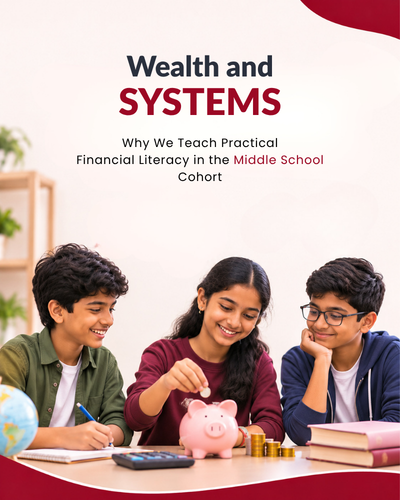
Wealth and Systems
Why We Teach Practical Financial Literacy in the Middle School Cohort
In today’s rapidly evolving world, financial awareness is no longer a skill reserved for adults. From managing personal expenses to understanding investments, business operations, and economic systems, financial literacy plays an important role in making informed life decisions. Yet, many children grow up learning mathematical formulas without understanding how those concepts translate into everyday financial situations.
What does it mean to manage money responsibly? How does a business decide where to invest its resources? Why is budgeting important? What makes a financial decision ethical?
These are questions children should begin exploring long before they enter adulthood.
At Kairos International School, the approach to education goes beyond conventional classroom learning. By introducing practical financial concepts during the middle school years, students can begin developing financial awareness, decision-making abilities, and a responsible understanding of wealth creation.
For parents in Nanakramguda, Gachibowli, and the Financial District who value practical education, financial literacy is an important part of preparing children for an increasingly complex world.
Why Financial Literacy Should Begin in Middle School
Middle school is an important stage in a child’s development. Students begin developing greater independence, understanding social responsibilities, and making decisions that influence their everyday lives.
Introducing financial literacy at this stage helps them connect mathematical knowledge with practical situations.
While traditional mathematics teaches students how to calculate percentages, ratios, and totals, financial literacy demonstrates where these concepts are used in real life.
For example, calculating a percentage becomes more meaningful when students use it to understand discounts, savings, or simple interest. Learning addition and subtraction becomes practical when they prepare a monthly budget or track expenses.
Financial literacy also introduces students to essential concepts such as:
- Budgeting: Understanding income, expenses, savings, and spending limits.
- – Resource Allocation: Learning how to distribute limited resources effectively.
- Saving and Planning: Understanding the importance of setting financial goals.
- Ethical Wealth Creation: Recognising the importance of honesty, responsibility, and fairness in financial decisions.
- Decision-Making: Evaluating choices and understanding their short-term and long-term consequences.
These concepts help children develop a thoughtful relationship with money rather than viewing it simply as something to spend or save.
How Kairos Makes Financial Learning Practical
At Kairos International School, the objective of experiential learning is to help students understand concepts by applying them in meaningful situations.
Financial literacy becomes particularly effective when students are given opportunities to make decisions, manage resources, and learn from the outcomes.
1. Learning Budgeting Through Real-World Simulations
One of the simplest ways to introduce financial responsibility is through budgeting exercises.
Students can be presented with a hypothetical monthly budget and asked to allocate resources across different categories, such as essential expenses, savings, education, and recreation.
They must consider priorities, identify unnecessary expenses, and understand the consequences of exceeding their budget.
For instance, a classroom activity might involve planning an educational event with a fixed amount of money. Students would need to estimate costs, compare options, distribute available funds, and ensure that the event remains within budget.
Such activities introduce the importance of planning and accountability while strengthening mathematical and analytical abilities.
2. Middle School Enterprise Projects: Understanding How Businesses Work
Financial literacy becomes even more engaging when students explore how businesses operate.
Enterprise-based learning activities can introduce students to the fundamentals of entrepreneurship, including identifying opportunities, estimating costs, pricing products, and understanding revenue and expenses.
Imagine students planning a small classroom enterprise. They must decide what to offer, calculate the cost of materials, determine a suitable selling price, and estimate potential earnings.
Through this process, they begin understanding the relationship between investment, production, pricing, and profitability.
More importantly, students learn that successful enterprises depend on planning, collaboration, creativity, and ethical decision-making.
These interdisciplinary projects also connect mathematics, business awareness, communication, and problem-solving into one meaningful learning experience.
3. Student-Led Projects and Financial Responsibility
Giving children responsibility is one of the most effective ways to develop independence.
Student-led initiatives, such as school events, fundraising activities, and collaborative projects, can create opportunities to understand financial management firsthand.
For example, when students participate in planning a fundraising activity, they can learn to estimate expenses, prepare a project budget, monitor spending, and maintain transparent records.
They also begin understanding that financial decisions affect other people and that responsible resource management requires accountability.
Such experiences can help students appreciate the value of teamwork, leadership, and responsible decision-making.
4. Understanding Wealth, Systems, and Ethical Decisions
Financial literacy is not limited to earning and spending money. It also involves understanding the larger systems that influence economic activity.
Middle school students can gradually explore how businesses create value, how supply and demand influence prices, and why resources must be allocated carefully.
Discussions around responsible consumption, entrepreneurship, sustainability, and fair business practices can help children understand that wealth creation also carries social responsibilities.
For example, students could compare two hypothetical businesses: one that focuses only on short-term profits and another that balances profitability with environmental responsibility and fair treatment of employees.
Analysing these situations encourages students to think beyond numbers and consider the ethical dimensions of financial decisions.
Why Practical Financial Education Matters for Hyderabad's Young Learners
Hyderabad’s growing technology, finance, and business ecosystem offers children an interesting environment in which to understand entrepreneurship and economic development.
For families living in Gachibowli, Nanakramguda, and the Financial District, children are growing up around professionals who work in technology, banking, consulting, business management, and entrepreneurship.
However, exposure to successful industries alone does not automatically develop financial awareness.
Children need structured opportunities to understand how money, resources, businesses, and economic systems function.
This is why parents searching for financial literacy for kids in Hyderabad, practical learning in middle schools in the Financial District, should consider how effectively a school’s curriculum connects classroom knowledge with real-world applications.
Whether students eventually pursue engineering, medicine, entrepreneurship, finance, or other career paths, financial awareness remains a valuable life skill.
At Kairos International School, experiential learning and interdisciplinary educational approaches aim to make learning more relevant by connecting academic concepts with practical situations.
Preparing Students for a Financially Responsible Future
The purpose of financial literacy education is not to turn middle school students into professional investors or business leaders. It is to help them become informed individuals who understand the value of money, recognise financial responsibilities, and make thoughtful decisions.
When children learn to budget, allocate resources, evaluate choices, and understand ethical wealth creation, they develop abilities that extend far beyond the classroom.
At Kairos International School, the vision is to create meaningful learning experiences that prepare students for the opportunities and responsibilities of tomorrow.
Because education should not only teach children how to solve mathematical problems. It should also help them understand the systems that shape everyday life.
Give your child the confidence to understand money, make responsible choices, and think independently.
Explore the learning approach at Kairos International School and discover how practical, experiential education can prepare students for life beyond textbooks. Schedule a campus visit today and experience a learning environment that values knowledge, independence, and real-world readiness.