- September 10, 2026
- By Kairos
Personalized Learning Kairos International School
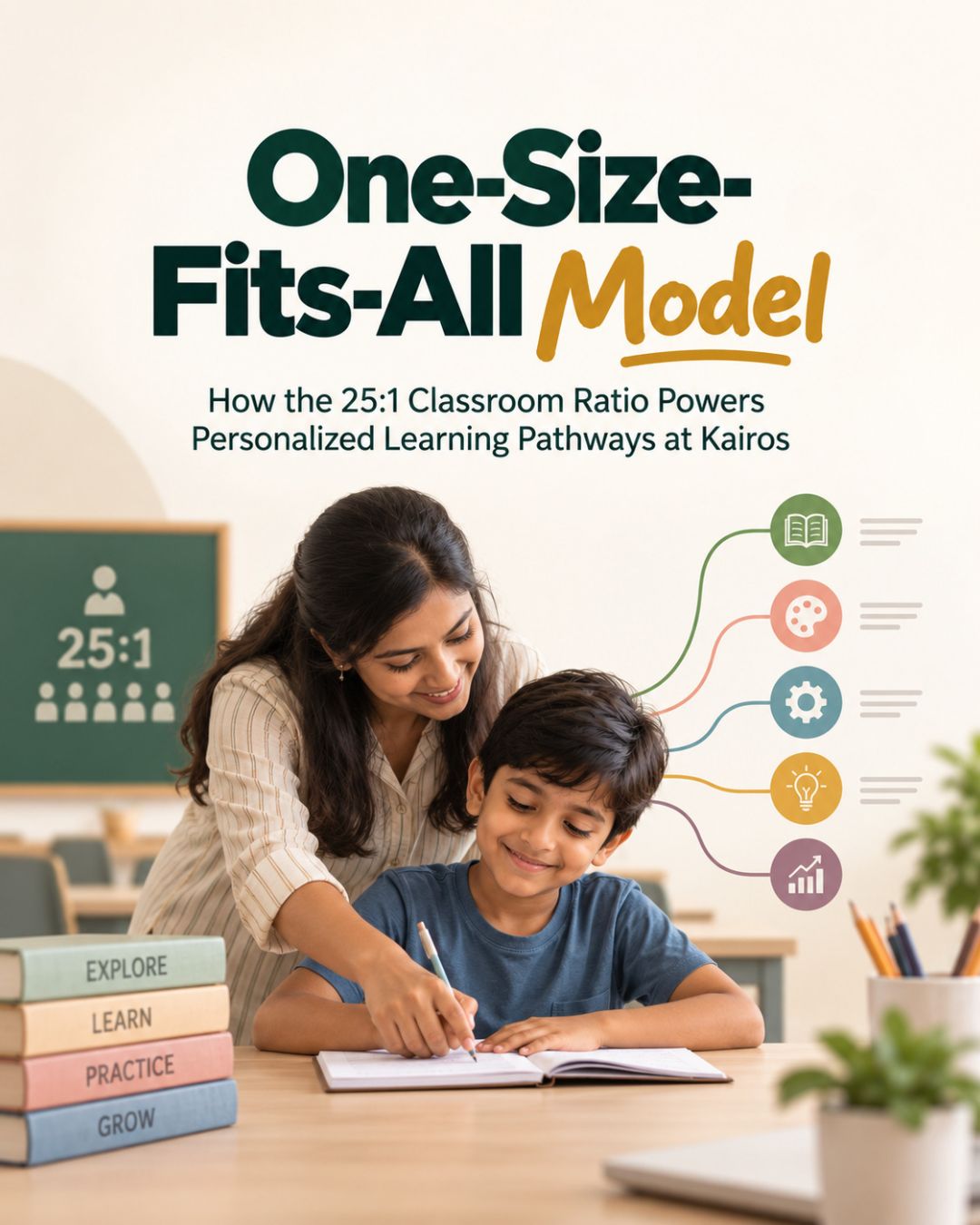
How the 25:1 Classroom Ratio Powers Personalized Learning Pathways at Kairos
For many parents in Hyderabad’s Financial District, choosing a school is no longer simply about finding a strong academic curriculum. They are asking a more important question: Will my child actually be seen, understood and guided as an individual?
It is a reasonable concern. In a crowded classroom, even highly capable teachers can struggle to give every student the attention they need. Some children may be ready to move ahead, while others may need more time, explanation or encouragement. Yet when everyone is expected to learn at the same pace, these differences can easily go unnoticed.
This is where the student-teacher ratio becomes more than just a number. At Kairos International School, the 25:1 classroom ratio is designed to create the conditions for meaningful interaction, personalised learning and stronger teacher mentorship.
Why Numbers Matter in the Classroom
A classroom is not simply a space where information is delivered. It is an environment where children ask questions, make mistakes, collaborate, develop confidence and gradually understand how they learn best.
For that to happen, teachers need the bandwidth to observe their students.
In an overcrowded classroom, much of a teacher’s attention can naturally go towards managing the group, completing administrative work and keeping lessons moving. There is less opportunity to notice the quieter student who has stopped participating, the learner who has mastered a concept early or the child who understands the answer but lacks the confidence to speak.
A balanced 25:1 classroom ratio creates more room for these observations.
At the other extreme, extremely small groups may provide greater individual attention but can sometimes reduce the diversity of perspectives and peer interaction that makes collaborative learning valuable. Children also learn from one another. They benefit from different ideas, personalities, approaches and ways of solving problems.
The goal, therefore, is not simply to make classrooms smaller. It is to find a thoughtful balance where individual attention and collaborative learning can exist together.
That balance can help create a classroom where students feel comfortable participating, asking questions and making mistakes without feeling lost in the crowd.
Moving Beyond the One-Size-Fits-All Model
Children do not arrive at school with identical learning profiles.
One student may grasp mathematical concepts quickly but need additional support with writing. Another may excel in language but require more practice before feeling confident in science. Some students thrive when they investigate independently, while others benefit from guided explanations and repeated practice.
A personalised learning pathway recognises these differences rather than treating them as problems.
With a well-balanced classroom, teachers have greater opportunity to understand where each learner is and adjust their approach accordingly.
For accelerated learners, this can mean deeper questions, additional challenges and opportunities to explore concepts beyond the basic curriculum. For students who need reinforcement, it can mean targeted explanations, additional practice and timely intervention before a learning gap becomes a larger obstacle.
This is where formative feedback becomes especially important.
Instead of relying only on examinations or mid-term grades to understand progress, teachers can continually observe classroom participation, questioning, assignments, projects and problem-solving approaches. These smaller feedback loops provide a more complete picture of a child’s development.
The question shifts from “What marks did the student get?” to “What does this student understand, where are they struggling and what can help them move forward?”
That is the foundation of genuinely personalised education.
Supporting Different Learning Pathways
Personalisation becomes even more important in a school environment that supports diverse academic pathways.
At Kairos International School, students can pursue Cambridge and CBSE curricula, each offering its own approach to academic learning. While curriculum structures provide an important framework, effective teaching still depends on understanding the learner within that framework.
A teacher who knows a student well can recognise their strengths, identify areas that need attention and provide feedback that is relevant to their individual learning journey.
This helps prevent curriculum from becoming a rigid checklist.
Instead, the curriculum becomes a framework through which students can develop critical thinking, inquiry, communication, problem-solving and independent learning skills.
The Kairos Standard: From Teacher to Mentor
The impact of a balanced classroom ultimately comes down to the people within it.
At Kairos International School, certified and experienced educators are positioned not simply as lecturers delivering lessons, but as mentors who actively engage with their students.
That distinction matters.
A mentor knows when to challenge a student and when to provide support. They recognise patterns in a child’s learning behaviour. They encourage questions rather than simply providing answers. Most importantly, they understand that academic achievement is only one part of a child’s development.
The learning environment itself supports this philosophy. Purpose-built spaces and modern infrastructure are designed to encourage interaction, collaboration and active participation rather than creating an environment centred entirely on competition.
The result is a school experience where students can learn with and from one another, while still receiving the individual guidance they need.
Looking at the Whole Child
Personalised learning should not stop at academics.
A child’s confidence, communication skills, relationships, emotional awareness and ability to work with others all influence how they learn and how they eventually navigate the world beyond school.
This is why Personal, Social and Emotional Skills (PSES) are an important part of the learning experience at Kairos.
When teachers have the opportunity to understand their students beyond their examination scores, they can support these areas as part of everyday school life.
A student who learns to communicate an idea clearly, collaborate with peers, handle setbacks and reflect on their own strengths is developing capabilities that extend well beyond the classroom.
Investing in Individual Potential
Global-standard education is often associated with impressive campuses, advanced facilities and international curricula. These elements certainly contribute to a school experience, but they are not the complete picture.
The more important question is what happens at the desk.
Does the teacher know when a student is struggling? Can they challenge a learner who is ready to go further? Is there enough space for questions, discussion and meaningful feedback? Does the child feel like one student among many, or as an individual whose progress matters?
A carefully considered 25:1 student-teacher ratio cannot answer every one of these questions on its own. But it can create the foundation for teachers to do what matters most: know their students well enough to teach them as individuals.
A carefully considered 25:1 student-teacher ratio cannot answer every one of these questions on its own. But it can create the foundation for teachers to do what matters most: know their students well enough to teach them as individuals.
For families in Tellapur, Hyderabad and the Financial District, this is worth experiencing beyond a brochure or website.
Visit Kairos International School, walk through the learning spaces and observe how intentional classroom design and class sizes come together to create a more personalised learning environment.
Because the future belongs not simply to students who can remember what they were taught, but to independent thinkers who understand how to learn, question and grow.